
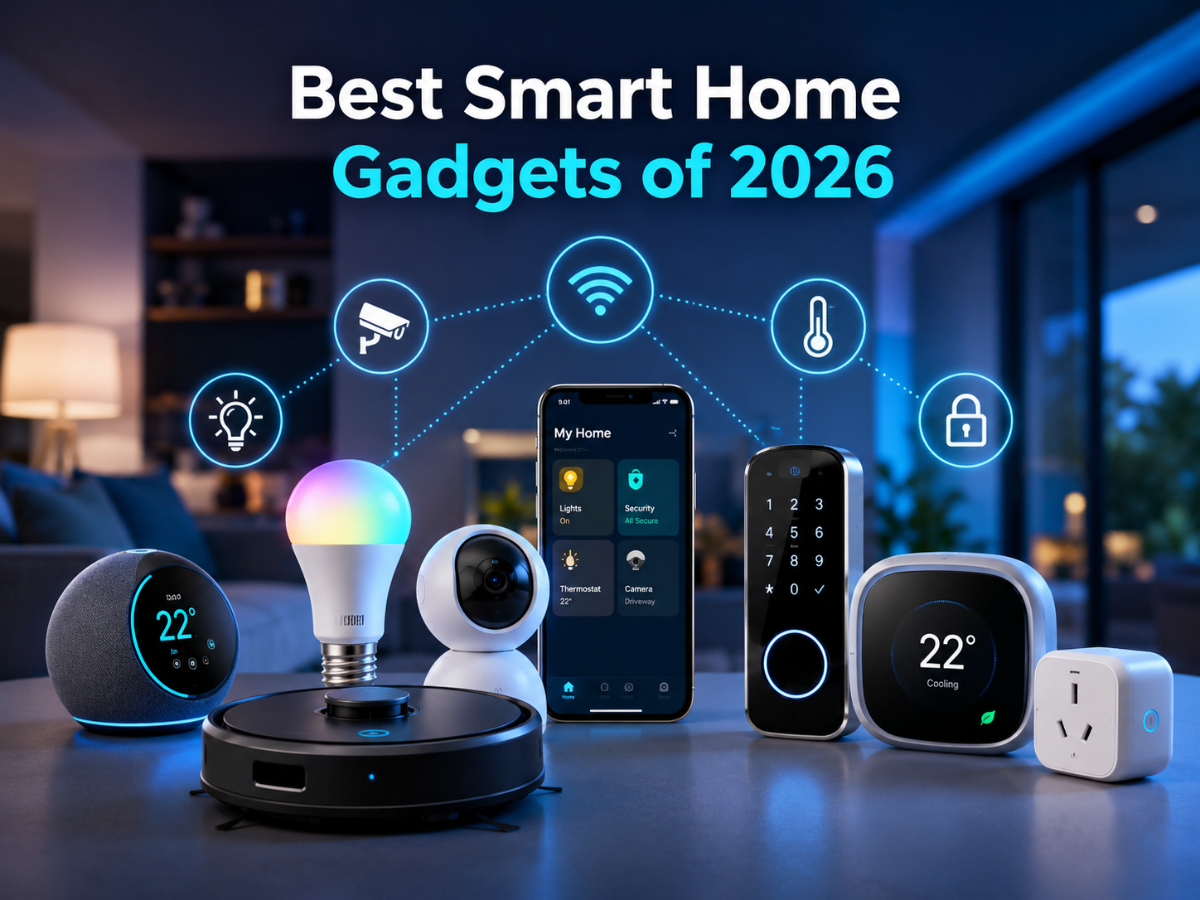
Best Smart Home Gadgets 2026: As you know now, smart homes are evolving from controlling individual gadgets to making the entire house work together. As of 2026, from top to bottom, all companies are focusing on smarter automation, better security, artificial intelligence, and wider device compatibility.
The biggest change is that smart devices are becoming easier to connect. Matter support is spreading across products, while Thread is helping compatible devices communicate through a reliable mesh network. At the same time, manufacturers are adding AI and better sensors to make devices respond to what is actually happening inside the home.
From smart locks and thermostats to robot cleaners and connected lights, here is a look at some of the smart home gadgets and features that stand out in 2026.
What Are the Best Smart Home Gadgets in 2026?
Smart lighting, security cameras, smart locks, thermostats, robot vacuums, smart plugs, and home hubs remain among the most useful categories.
This year’s products focus more on practical features than flashy specifications. For example, newer presence sensors can detect whether people are sitting, standing, or moving in a room. That information can help a home automatically adjust lights, temperature, or other connected devices.
The trend also extends to robotic cleaners. Roborock’s Saros Rover attracted attention at CES 2026 because it can climb and clean stairs, taking robot vacuum technology beyond traditional floor cleaning.
How Is AI Changing Smart Homes in 2026?
Artificial intelligence is becoming an important part of home automation. Instead of simply following fixed commands, newer devices can use sensors and software to understand activity and respond accordingly.
Security cameras can become more useful when they identify activity instead of sending alerts for every small movement. Smart-home systems can also use information from multiple sensors to trigger more useful routines.
Companies are also exploring local AI processing. This approach can reduce the need to send every piece of information to the cloud and could improve privacy and response times.
What Is Matter, and Why Does It Matter for Smart Homes?
Matter remains one of the biggest developments in the smart-home market.
The standard aims to make devices from different manufacturers work together more easily. This means users can have products from different brands without necessarily building their entire home around one ecosystem.
CES 2026 highlighted this shift, with smart locks, cameras, sensors, and other products adding Matter compatibility. Thread also received significant attention because it can create a mesh network for compatible smart-home devices.
For buyers, Matter support can make future upgrades easier and reduce compatibility concerns.
Best Smart Locks and Home Security Gadgets
Smart locks are moving beyond simple smartphone unlocking. Manufacturers are experimenting with biometric authentication, including palm-vein scanning and facial recognition.
The Lockin V7 Max, for example, combines palm and finger-vein scanning with facial recognition, cameras, and Matter support. These features show how smart locks are increasingly becoming complete security devices rather than simple electronic door locks.
The wider home-security market is also adding better cameras, video doorbells, and connected sensors. Recent 2026 launches include dual-lens security cameras, battery-powered video doorbells, and affordable indoor cameras.
Best Smart Thermostats and Smart Sensors
Smart thermostats are also becoming more versatile. Aqara’s Thermostat Hub W200 combines temperature control with a presence sensor and smart-home hub functions.
Its millimeter-wave sensor can detect people even when they remain relatively still. The device can also connect with Matter products, giving it a wider role within a connected home.
Sensors are becoming smarter too. Aqara’s Spatial Multi-Sensor FP400 can track multiple people and use their positions or movements to trigger automations.
Smart Lights Are Getting More Creative
Smart lighting no longer means simply changing a bulb from white to blue.
Govee’s Ceiling Light Ultra uses hundreds of LEDs to create colorful lighting effects and display visuals. Philips Hue has also introduced SpatialAware, which uses a phone’s camera and LiDAR to understand the position of lights in a room and create more realistic lighting scenes.
These features could make lighting more immersive for movies, gaming, parties, and everyday use.
Are Smart Home Gadgets Worth Buying in 2026?
For most users, the best approach is to start with devices that solve an everyday problem. A smart plug, security camera, smart light, thermostat, or compatible lock can provide more practical benefits than buying several expensive gadgets at once.
Matter support should also remain an important buying factor. It can make it easier to connect products from different brands and reduce dependence on a single smart-home ecosystem.
The 2026 smart-home market shows a clear shift: gadgets are becoming less about novelty and more about automation, compatibility, and convenience. AI, better sensors, Matter, and smarter robotics could make connected homes significantly easier to manage in the coming months.